Have a great weekend!
🎸😎🌹🍾🚗😆
.
WA: 08561772722
Location: Halim Jaktim
.
80s Rock Sounds:
Proco RAT,
Empress Tremolo,
Empress Tape Delay,
MXR Phase 90,
HOF Reverb,
VA Straight Flush,
AMT V1,
Dunlop Cry Baby,
Tuner TU-3,
Pedalboard
#pedalboard #pedalboardmadness #pedalboardoftheday #pedalboardporn #guitarriff #riffwars #lickwars #guitarpedals #guitareffects #procorat #ratpedal #empresstapedelay #straightflush #mxrpedals #phase90 #clydemccoywah
________________________________
#hofmini #empresstremolo #empresspedals #dunloppedals #dcbrick #vanhalen #extremeband #nunobettencourt #80srock #lespaul #efekgitar #eddievanhalen #jualefek #jualefekgitar
Showing posts with label rock guitar. Show all posts
Showing posts with label rock guitar. Show all posts
Tuesday, February 25, 2020


Tuesday, September 29, 2015
Slash Guitar Analysis
Slash has a very unique lead playing style. His style is bluesy and
soulful, and sometimes ventures off to include notes that are not part
of the standard blues scale. Slash can play very emotional, wailing
melodies, but also rough and fast pieces when the song calls for it.
There is something unashamed and primal about his playing — it’s almost
sexy.
As Axl Rose said in 1988 during Guns N’ Roses’ timeless performance captured on Live at the Ritz, “In a world he that he did not create, but he will go though as if it was his own making: half man, half beast … I’m not sure what it is, but whatever it is, it’s weird and it’s pissed off and it calls itself SLASH.”
In this post I want to highlight some of the things that strike me as being typical of Slash’s style. I don’t want to talk about specific licks as I think ultimately this is a bit limiting. While knowing how to play specific licks can be very useful, what I want to convey in this post are ideas — several ways to approach particular notes to create a certain feel. You can then incorporate these ideas into your own lead playing.
First, let’s start off with the scale that Slash tends to build most of his solos around. It’s the standard blues scale, and in standard position it is given by:
Most of the solos on Guns n’ Roses’ albums Appetite for Destruction, Use Your Illusion 1 and Use Your Illusion 2 are built around this scale. Slash occasionally extends this scale to include more notes if the song calls for it.
Slash uses this scale a lot in ballads where the standard blues scale would sound a bit too rebellious. The major pentatonic scale sounds more harmonious than the standard blues scale when played against major scale chord progressions. This is perfect for ballads where the melody should add to the mood of the song rather than rebel against it, which is what tends to happen when you play the blues scale.
Listen to ballads like “November Rain” or “Estranged” to hear this scale in action.
The power comes from being able to mix this scale with the blues scale. Each scale adds their own different feel to a solo. Go to the Examples section to see a video that illustrates this idea.
The following chart shows the scale in all its glory with the standard blues scale as reference (semi-transparant). Slash usually adds the perfect fourth, as highlighted in yellow.
Slash bends this note by three semitones. This is something that I think is one of those things that really defines Slash’s lead style. That note, when bent by three semitones, followed by picking the fifth, augmented fourth, perfect fourth and minor third sounds absolutely great. It’s like turbo-charged blues.
Have a listen to Slash’s solo on Lenny Kravitz’s “Mama Said” to hear this in action. It’s that one note that really stands out to me. See if you can spot it.
Listen to songs such as Guns n’ Roses’ “You Could be Mine” or “Garden of Eden” for an example.
to be continued
As Axl Rose said in 1988 during Guns N’ Roses’ timeless performance captured on Live at the Ritz, “In a world he that he did not create, but he will go though as if it was his own making: half man, half beast … I’m not sure what it is, but whatever it is, it’s weird and it’s pissed off and it calls itself SLASH.”
In this post I want to highlight some of the things that strike me as being typical of Slash’s style. I don’t want to talk about specific licks as I think ultimately this is a bit limiting. While knowing how to play specific licks can be very useful, what I want to convey in this post are ideas — several ways to approach particular notes to create a certain feel. You can then incorporate these ideas into your own lead playing.
First, let’s start off with the scale that Slash tends to build most of his solos around. It’s the standard blues scale, and in standard position it is given by:
 |
| Blues Scale in Standard Position |
Most of the solos on Guns n’ Roses’ albums Appetite for Destruction, Use Your Illusion 1 and Use Your Illusion 2 are built around this scale. Slash occasionally extends this scale to include more notes if the song calls for it.
Idea #1: Mixing minor and major scales
Take the standard blues scale in standard position. Now shift the whole pattern down by three semitones. What you are left with is the major pentatonic scale with the addition of the minor third.
Slash uses this scale a lot in ballads where the standard blues scale would sound a bit too rebellious. The major pentatonic scale sounds more harmonious than the standard blues scale when played against major scale chord progressions. This is perfect for ballads where the melody should add to the mood of the song rather than rebel against it, which is what tends to happen when you play the blues scale.
Listen to ballads like “November Rain” or “Estranged” to hear this scale in action.
The power comes from being able to mix this scale with the blues scale. Each scale adds their own different feel to a solo. Go to the Examples section to see a video that illustrates this idea.
The following chart shows the scale in all its glory with the standard blues scale as reference (semi-transparant). Slash usually adds the perfect fourth, as highlighted in yellow.
 |
| Slash's Major Scale Pattern |
Idea #2: Overbending the perfect fifth
Let’s go back to the standard blues scale. In particular, have a look at the perfect fifth.
Slash bends this note by three semitones. This is something that I think is one of those things that really defines Slash’s lead style. That note, when bent by three semitones, followed by picking the fifth, augmented fourth, perfect fourth and minor third sounds absolutely great. It’s like turbo-charged blues.
Have a listen to Slash’s solo on Lenny Kravitz’s “Mama Said” to hear this in action. It’s that one note that really stands out to me. See if you can spot it.
 |
| The Perfect Fifth |
Idea #3: Adding the major sixth
When a song calls for it, Slash is no stranger to playing fast phrases. And when he does he adds the major sixth to the blues scale. This is a note that stands out when added to the standard blues scale and gives the melody a different feel.
Listen to songs such as Guns n’ Roses’ “You Could be Mine” or “Garden of Eden” for an example.
 |
| Major 6th Added |
to be continued
Wednesday, February 4, 2015
The Reason: DOUG ALDRICH Leaving WHITESNAKE

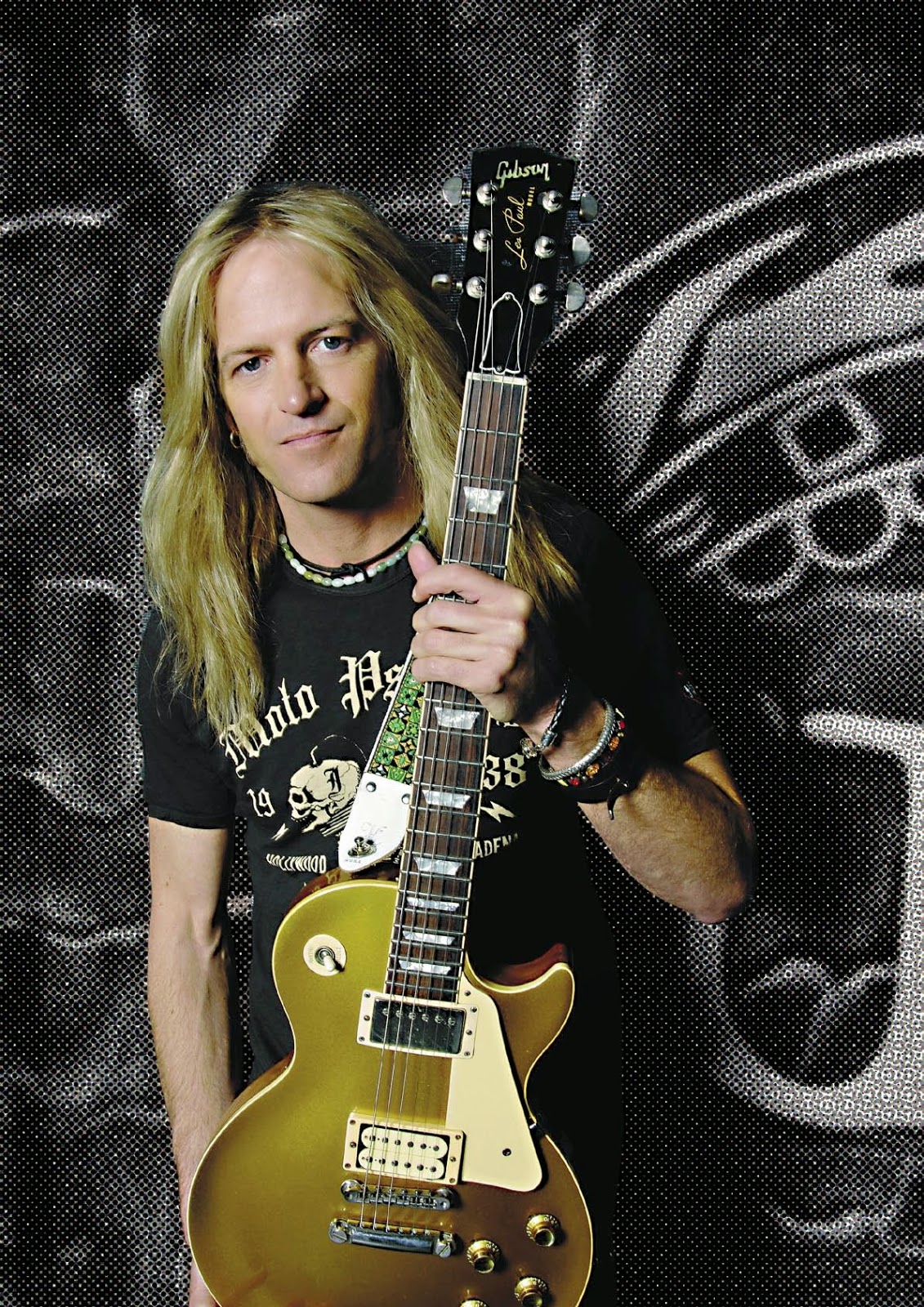
A week after announcing his departure from WHITESNAKE, guitarist Doug Aldrich
has released a new statement explaining the reasons behind his decision
to leave the group as well as offering a glimpse into his musical
future.
Said Doug: "As there is still some question regarding my situation with WHITESNAKE, I want to officially clear the air.
"I can confirm that on May 7th, I made the insanely difficult decision to leave the WHITESNAKE band.

"At that time, although not contractually bound, I moved forward with David [Coverdale, WHITESNAKE singer and leader] starting pre-production for an upcoming WHITESNAKE project. Coinciding with my with the start of that project, I also had several recording and live commitments, so I needed a more flexible schedule to conclude these before going full force as normal. Unfortunately, my schedule was not workable.
"As usual, the results between me and David were extremely positive and fun, so that made the decision even harder.

"I treasured my 11-plus years in the band. Two studio records, two DVDs, three live records and roughly 30 Coverdale/Aldrich songs! Killer...
"The privilege of being an ambassador for WHITESNAKE is a responsibility I took very seriously.
"David started the band 35 years ago with high integrity. It was an honor to maintain that standard while I was in. And now, like lots of great things, it has come to an end.
"I want to thank the great WHITESNAKE band. Reb [Beach, guitar], Michael [Devin, bass], Tommy [Aldridge, drums], Big Foot [Brian] Tichy, Rudy [Sarzo], Marco [Mendoza], Uriah [Duffy], Timothy [Drury] and the Fraz [Chris Frazier] for the good times, great shows and records always kicking major ass over these years. The opportunity travel the world together with such amazing musicians in so many countries was just unreal.

"For me, this is a new beginning and area of my musical future. I'll definitely be moving forward working on new music, recording and touring and will have a bit more time to pursue some offers that I never had time to fit in before. A fresh start, new ideas, and another chance to push myself as a musician.
"Thank you, brother DC, for the great times and for allowing me space to put my heart and soul into the history of your great band."

Aldrich played on the last two WHITESNAKE studio albums, 2008's "Good To Be Bad" and 2011's "Forevermore", and appeared on several live releases, including last year's "Made In Japan" and "Made In Britain/The World Records".
Asked in a 2013 interview with Classic Rock Revisited how he has been able to stay in WHITESNAKE so long considering how "tough on guitar players" David has been throughout the years, Doug said: "Honestly, I think he really cares about how hard I work and how much I care about his musical vision. I might make a mistake and overstep my bounds, now and then, but David knows I am only doing it because I really care. I think that is a part of it. My style fits in with him, as well. Reb [Beach, WHITESNAKE's other guitarist] and I really work well together for WHITESNAKE as well.
Doug added: "I think for me, [Coverdale] is at the point to where he does not need to prove anything to anybody, but he still wants to move forward, anyway. I love that. At the same time, I'm going, 'Let's try this!' I am not pushing him, but I am enthusiastic about our music. I love the guy and he is one of a kind and I have a lot of respect for the fact that he is still going for it. I love being in WHITESNAKE and David knows it. By the same token, if David said to me that he wanted to go back to any one of the past guitar players, I would absolutely respect that and I would be appreciative of everything that we've done together."

Regarding how he came to join WHITESNAKE, Doug said: "When David first contacted me about doing WHITESNAKE, I had heard he was going to reform the version of WHITESNAKE with John Sykes. I said, 'David, there is no reason for you to talk to me if you're thinking of getting back with Sykes. I have my own thing to offer and I am not going to be in a band with him.' David said,'No, no, no, I want you.' So I thought, 'Yes!' 'Okay, cool. Let's talk.'

"There was a period, in 2003, where he said that he might do something with previous members and he wondered if I would consider being a part of it. At the time, I said no because I hadn't put my mark on WHITESNAKE yet. It wouldn't have felt right to me at that early time. Now we have 30-plus songs together and I'm very proud of them. Now we jam with past members all the time and its fun. I am humble and inspired working with David and very thankful for our relationship."

Aldrich has spent the past few months performing with Raiding The Rock Vault — dubbed "the ultimate classic rock concert experience" — which plays the LVH Hotel And Casino in Las Vegas four or five times a week. Boasting the ultimate set list, the show takes audiences on a magical musical journey, traversing the genre's history from the '60s through the '80s.

Raiding The Rock Vault features classic anthems from THE ROLLING STONES, THE WHO, THE DOORS, LED ZEPPELIN, JIMI HENDRIX, THE EAGLES, QUEEN, VAN HALEN, AC/DC, JOURNEY, FREE, BRYAN ADAMS, SUPERTRAMP, TOTO, DEEP PURPLE, and more.
Said Doug: "As there is still some question regarding my situation with WHITESNAKE, I want to officially clear the air.
"I can confirm that on May 7th, I made the insanely difficult decision to leave the WHITESNAKE band.
"At that time, although not contractually bound, I moved forward with David [Coverdale, WHITESNAKE singer and leader] starting pre-production for an upcoming WHITESNAKE project. Coinciding with my with the start of that project, I also had several recording and live commitments, so I needed a more flexible schedule to conclude these before going full force as normal. Unfortunately, my schedule was not workable.
"As usual, the results between me and David were extremely positive and fun, so that made the decision even harder.
"I treasured my 11-plus years in the band. Two studio records, two DVDs, three live records and roughly 30 Coverdale/Aldrich songs! Killer...
"The privilege of being an ambassador for WHITESNAKE is a responsibility I took very seriously.
"David started the band 35 years ago with high integrity. It was an honor to maintain that standard while I was in. And now, like lots of great things, it has come to an end.
"I want to thank the great WHITESNAKE band. Reb [Beach, guitar], Michael [Devin, bass], Tommy [Aldridge, drums], Big Foot [Brian] Tichy, Rudy [Sarzo], Marco [Mendoza], Uriah [Duffy], Timothy [Drury] and the Fraz [Chris Frazier] for the good times, great shows and records always kicking major ass over these years. The opportunity travel the world together with such amazing musicians in so many countries was just unreal.
"For me, this is a new beginning and area of my musical future. I'll definitely be moving forward working on new music, recording and touring and will have a bit more time to pursue some offers that I never had time to fit in before. A fresh start, new ideas, and another chance to push myself as a musician.
"Thank you, brother DC, for the great times and for allowing me space to put my heart and soul into the history of your great band."
Aldrich played on the last two WHITESNAKE studio albums, 2008's "Good To Be Bad" and 2011's "Forevermore", and appeared on several live releases, including last year's "Made In Japan" and "Made In Britain/The World Records".
Asked in a 2013 interview with Classic Rock Revisited how he has been able to stay in WHITESNAKE so long considering how "tough on guitar players" David has been throughout the years, Doug said: "Honestly, I think he really cares about how hard I work and how much I care about his musical vision. I might make a mistake and overstep my bounds, now and then, but David knows I am only doing it because I really care. I think that is a part of it. My style fits in with him, as well. Reb [Beach, WHITESNAKE's other guitarist] and I really work well together for WHITESNAKE as well.
Doug added: "I think for me, [Coverdale] is at the point to where he does not need to prove anything to anybody, but he still wants to move forward, anyway. I love that. At the same time, I'm going, 'Let's try this!' I am not pushing him, but I am enthusiastic about our music. I love the guy and he is one of a kind and I have a lot of respect for the fact that he is still going for it. I love being in WHITESNAKE and David knows it. By the same token, if David said to me that he wanted to go back to any one of the past guitar players, I would absolutely respect that and I would be appreciative of everything that we've done together."
Regarding how he came to join WHITESNAKE, Doug said: "When David first contacted me about doing WHITESNAKE, I had heard he was going to reform the version of WHITESNAKE with John Sykes. I said, 'David, there is no reason for you to talk to me if you're thinking of getting back with Sykes. I have my own thing to offer and I am not going to be in a band with him.' David said,'No, no, no, I want you.' So I thought, 'Yes!' 'Okay, cool. Let's talk.'
"There was a period, in 2003, where he said that he might do something with previous members and he wondered if I would consider being a part of it. At the time, I said no because I hadn't put my mark on WHITESNAKE yet. It wouldn't have felt right to me at that early time. Now we have 30-plus songs together and I'm very proud of them. Now we jam with past members all the time and its fun. I am humble and inspired working with David and very thankful for our relationship."
Aldrich has spent the past few months performing with Raiding The Rock Vault — dubbed "the ultimate classic rock concert experience" — which plays the LVH Hotel And Casino in Las Vegas four or five times a week. Boasting the ultimate set list, the show takes audiences on a magical musical journey, traversing the genre's history from the '60s through the '80s.
Raiding The Rock Vault features classic anthems from THE ROLLING STONES, THE WHO, THE DOORS, LED ZEPPELIN, JIMI HENDRIX, THE EAGLES, QUEEN, VAN HALEN, AC/DC, JOURNEY, FREE, BRYAN ADAMS, SUPERTRAMP, TOTO, DEEP PURPLE, and more.
- Doug Aldrich, is a Los Angeles-based hard rock guitarist. He founded the band Burning Rain with Keith St. John in 1998 and has played previously with the bands Whitesnake, Dio, Lion, Hurricane, House of Lords, and Bad Moon Rising. Wikipedia
- Born: February 19, 1964 (age 50), Raleigh, North Carolina, United States
- Spouse: Daniela W. Aldrich (m. 2014)
Source: www.blabbermouth.net
Thursday, February 6, 2014
Samick JTR Marie Elite MR30FR Demo by Ray
>>>CUCI GUDANG<<<
Langsung aja dtg k garasi Areeya House. Whatsapp/WeChat/Line: 08561 772 722. Lokasi Halim Jakarta. PÎÑG aja ввм 32E36F53 ---->Katalog ada di FB Page: Ahad Is One
Langsung aja dtg k garasi Areeya House. Whatsapp/WeChat/Line: 08561 772 722. Lokasi Halim Jakarta. PÎÑG aja ввм 32E36F53 ---->Katalog ada di FB Page: Ahad Is One
Website: www.areeyahouse.com
Τнäηκчöü \m/ :D
Samick JTR Marie Elite MR30 FR (Floyd Rose)

Samick JTR Marie Elite MR30 FR
Samick has gone over the top with their new line of JTR series guitars, great for Metal, Jazz and Blues.
The Marie MR30 has a neck through body that sustains all day long, and the fast neck width and jumbo frets will have you playing notes that seem to play by themselves. It’s a masterpiece that is like a Stradivarius for guitar players...
Features:
Joint : Neck-thru
Scale : 25.5’’
Body : Swamp Ash
Neck : Maple
Fingerboard : Ebony
Bridge : Floyd Rose Special
Bridge Pickup : JTR Hot Humbucker
Neck Pickup : JTR Hot Humbucker
Control : 1 Vol / 1 Tone / 3 Way selector
Knob : Crystal Steel Knob
Hardware : Black Nickel
======================================================


Thursday, October 10, 2013
Samick Greg Bennett Avion Series: NEW N' RARE!! AV7 LTD BK (Limited-Black)


SOLD Alhamdulillaah


The AVION™ series guitars, while paying tribute to these original
designs, offers its own unique visual character and performance
benefits. Many players love the look of an arch top solid body, but are
not aware of the incredible performance benefits it provides.


The arch
top adds mass for rigidity under the bridge, preventing the body from
stealing energy from the string. This may add some weight, but the
improvement in attack and sustain is worth it. The maple top on a
mahogany body provides serious definition with an amazingly warm tone.
The single cutaway design shortens the exposed area of the neck, making
it more secure and therefore more rigid. Combining this with a set neck
greatly improves string performance.
Saturday, May 4, 2013
Dijual: MXR Distortion III seken fullset
 |
| MXR Distortion III seken fullset |
SOLD
Ane mau jual lg ni gan...
Seken lengkap dg dus dan segala isinya (spt difoto)...
Stompbox MXR Distortion III seken fullset.
Lokasi di Jakarta.
Stompbox Mania !
Sunnah tawar menawar, dilarang nett !!!
Areeya House
08561 772 722
...ane buka harga: SOLD
Sunday, April 28, 2013
Dijual: Fender Stratocaster MIJ Reissue '50s 1996

Dijual:
Fender Stratocaster Made in Japan (MIJ) Reissue '50s,
produksi tahun 1995-1996.
Kondisi fisik setengah relic, sekitar 85%.
Material seluruhnya original, belum pernah ada penggantian.
Sangat terasa bedanya, sangat nyaman di tangan ketika jari jemari memainkannya, sound mantab krn kayu dan pickups berkualitas..
Fast Response: 08561 772 722
Lokasi di Jakarta.
Bisa COD di seputaran Halim P.
Harga 6.5jt.
Cerita sedikit ttg gitar ini dan spec-nya:
Made by Fender Japan in the year Fender celebrated its 50th anniversary (1946-1996) as a company, this Strat is a tribute to 50's models.
The pickups have a beautiful sparkling tonality that is not harsh like some. The neck p/up is fat and crisp and playing Hendrix/SRV licks sounds authentic. The bridge is bright, but fat, and playing Hank Marvin tunes sent me back to another time. The guitar is finished in Sunburst and has a soft 'V' neck. Aged parts, kluson tuners and a single ply scratchplate give the guitar a true 50's vibe. Although it is now 16 years old, it is in mint condition. A nice find!
Model Name: Reissue ‘50s Stratocaster®
Model Number: 027-1002-(Color#)
Series: Collectables Series
Body: Basswood
Neck: Maple Soft “V” Shape
Fingerboard: Maple (7.25” Radius/184 mm)
No. of Frets: 21
Scale Length: 25.5” (648 mm)
Width @ Nut: 1.650” (42 mm0
Hardware: Chrome
Machine Heads: Vintage Style
Bridge: Vintage Style
Pickguard: 1-Ply White
Pickups: 3 Single Coils with Staggered Pole Pieces, Alnico Magnets, Aged Covers
Pickup Switching: 5 Position Blade
Controls: Master Volume, Tone (Neck), Tone (Mid)
Colors: (503) 2-Color Sunburst


Fender Strat MIJ Reissue '50s sekarang udh gk keluar lagi gan.. generasi terakhir yg pake istilah MIJ, setelah itu jd CIJ (Crafted in Japan) dsertai penurunan material sedikit (down-grade).
Fender Strat MIJ Reissue '50s ini diproduksi tahun 1995-1996, dlm rangka setengah abad ulang tahun Fender (1946-1996).. makanya ni gitar kalo bagi yg mengerti mah langsung disikat... hhehe.. :D

Reaksi cepat: 08561 772 722
COD Jakarta kalo hari kerja di seputaran Halim, weekend bs d Slipi, Benhil, Tebet, Cpk Ptih, atau transfer via: Mandiri atau BNI
Thursday, February 28, 2013
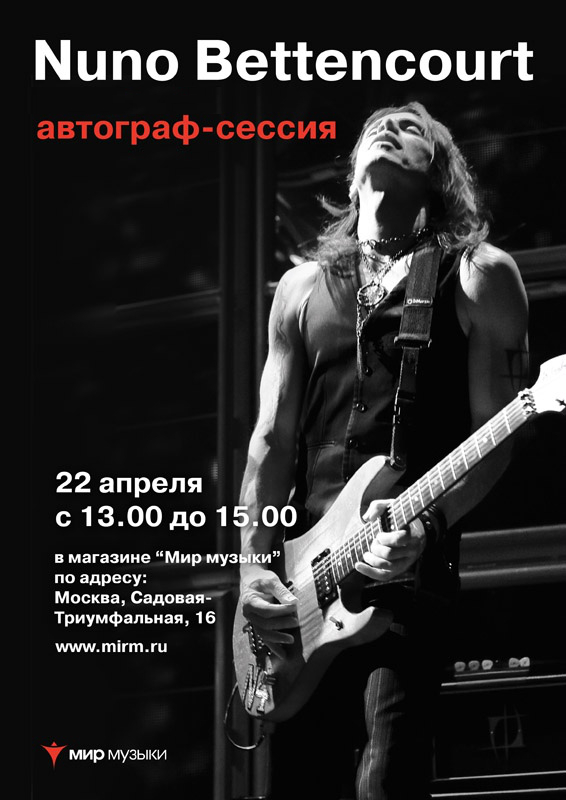
Nuno Bettencourt Interview

You really have to love rock music to support its traditions and its methods the way Extreme have always done. But you also have to have a strong sense of self to stand out from the crowd. How Extreme have managed to balance the classic and the personal throughout their 25-year career remains somewhat of a mystery, but you suspect that it has something to do with Nuno Bettencourt’s open and unconservative approach to music, his ability to mix instinct and reflection, and his willingness to take risks.
When in the early 90s the rock guitar virtuoso genre was on its last legs, instead of kicking it to the curb, Extreme gave it a new lease of life, if only for a few more years. Again, one suspects, out of sheer love for rock. The way Bettencourt embraced the Van Halen legacy betrayed an inner fan in him, but the way he spun it and took it into a new direction proved that we were dealing with a true artist. It all came naturally to Extreme, without calculation or deceptive methods, and this naturalness and refusal to follow a routine is perhaps what turned them into one of the best bands of their generation. After all, it takes more than phenomenal chops and hooky tunes to make a band truly great.


This organic mix of the old and the new, of the familiar and the unexpected, of traditional and personal, of the complex and the austere, comes through on Extreme’s new live album Take Us Alive with surprising vividness. Being back on the gigging circuit after a 13-year break must have felt like a real escapade for the band, and the material – recorded at the last homecoming show of a mammoth 75-city tour – reflects this sense of adventure with plenty of panache.

The band’s chemistry is infections – when the audience is not singing along, it is holding its breath for Bettencourt’s phenomenal leads. Sounding like they are having a blast, the band takes the crowd on a breathtaking romp from powerhouse rockers off their latest studio album Saudades de Rock through earthy acoustic balladry to tightly wound funky vamps and then back to big gold-plated bounce of cock-strutting oldies. Extreme are firing on all cylinders and the crowd is loving every second of it – the best proof to the fact that unity of form and substance is at the root of that special live magic.
Supporting tradition is one thing, but doing so while managing to sound modern and exciting is quite another. Extreme to this day manage to do both, and the result couldn’t have been more convincing. During our telephone chat Bettencourt tells me that the band has a word for balancing punch and polish, the unexpected and the familiar. They call it “simplex” – a combination of the simple and the complex.
I also find out that being on the road with Extreme never becomes a routine for Bettencourt, and that he continues to see these things as small challenges, as “another little mountain to climb.” His current tour with Rihanna, he says, is another one of those small mountains.


This unexpected collaboration between the world of rock and the world of pop, as well as broader things such as the current state of the music industry and the nature of creative aspiration were among other things we’ve touched upon. And in the end it all became very clear – intuition and flexibility are at the centre of Bettencourt’s vision. There isn’t and has never been any dogma, or any concession to a routine, and this is one of the main reasons why Extreme after all those years still remain who they are – to this day staying relevant, fresh, and utterly inimitable.
Hardrock Haven: I’d like to start with talking about the new live album and the accompanying DVD. How did it happen that all the past experience and all the new energy are suddenly coming together at one place and time on one given evening? Is it all just down to experience, musical knowledge and skill, or is there also this factor of spontaneous magic that is also at work there?
NB: I think that with live recordings, or live DVDs, or live albums, you kind of don’t know what you gonna get. Overall, we’ve never gone on stage and punched the clock, no matter how great or how bad the audience is. The passion that we have as performers and wanting to perform is always what kicks it off. I don’t think we’ve ever lost that in the best of times and the worst of times. The thing about Extreme is that when you see a live show, you see a live show, no matter what’s going on. And really the only difference is whether it becomes great, or special, or extra special, or maybe not so great, depends on the audience. It depends on the relationship that you have that night – whether they give you that extra energy to throw you over the edge, or whether sometimes you have to work a little extra to get it. It’s hard to say which show is the best, or which show we should have recorded. They are all very different. Playing in Madrid and playing in Tokyo is two completely different cultures and you can sense the difference when you are on stage.
HRH: But how do you balance such brilliant entertainment with conveying a meaningful musical message? Is this something that has to be thought about and balanced out beforehand, or is this something that happens spontaneously with Extreme?
NB: With rock n’ roll you always want to do a kind of simple thing, but you always want a little bit of complexity of melody, and lyrics, and arrangement, and musicianship. So the word that I always come up with is “simplex” – simple and complex. “Keep it simplex”. We are still a rock band, we are not curing any major diseases. We are here for entertainment, like all the bands that we grew up with – they are all pretty straightforward rock bands. But to make it your own we are all pretty decent players, and the bands that we grew up with did great harmonies and crazy arrangements once in a while. It’s something that is definitely thought about at composition stage. It’s not like something that we think about live. By the time we are on stage, if you haven’t got it all together, you’re in trouble.

HRH: But you say a very revealing thing on this record between the songs: “Rock n’ roll is not dead, but it sure is sick.” It seems to me that this is how you have felt about rock n’ roll throughout your career, and that has been one of your creative goals – to make rock n’ roll music healthier, more diverse, more viable, more resilient.
NB: I think that’s what it is, but I think that now it is even more so because of the state of the music business and the greatness and the danger of the internet. It is a great thing making the world smaller while we communicate, while we discover things, while we find things, but in many ways it has made it very easy to download stuff which everybody does, all of us do. It’s made it more difficult for record companies to continue being a big bank. When they used to be like big banks, they could allow artists like the Beatles to take three or four albums to get to Sgt. Pepper, they could allow any band like Queen to do those records, or David Bowie to develop different things. Nowadays the danger is that it becomes very hard. What will happen to these young bands that don’t get that chance to develop, or who don’t get the funds to tour the world or to take their first record and develop it into something else? The Beatles with Sgt. Pepper had the time, and those young bands don’t get another shot. It’s become like American Idol and like those quick-fix shows that get you discovered these days. That’s the danger. I don’t think rock has always been sick, it’s just that now it’s becoming very hard to find and discover some of the more special acts who should be making music history.


HRH: We are talking more about technology here, things like MySpace and YouTube, and illegal downloading. But from a purely creative point of view, from a point of view of a musician and a composer – do you think that those challenges that you were facing 20 years ago still remain the same or are they now different?
NB: Well, here is another worry about technology and the internet. When you are a kid, like I was in the middle of Massachusetts, in a small town – not in Boston – and you are anywhere that is more further away from the city, you have your surroundings to deal with, and those are minimal. Meaning that your choice is minimal and if you see a band that inspires you, in order to get there you have to do it yourself, you have to do your own work. You have to get better as a musician, you have to get better as a songwriter. Because you don’t have much where you live. You have to have imagination, lyrical and writing imagination, and dream of what it would be like to be on stage, and dream about what it would be like to have a conversation with Eddie Van Halen, or Jimmy Page, or any of those guys.
But nowadays you can have that by hitting the space bar. You can travel to an arena, and you can see the show on YouTube ten seconds after you saw the actual show. The mystery is gone. If you are waiting for a band to come into town, and you are in Texas and they are in Europe, by the time they get to Texas, you will see crappy versions of the concert at least 30 or 40 times if not more by other people who are video-recording with their phones. It’s natural, don’t get me wrong, but it demystifies everything. To the point where people go, “Why do I need to get out of the house to see a music show? I’ll see it on YouTube.” Or, “Why do I need to go and play in a club when I can just learn how to play guitar online?” That’s the danger of it. I think people are getting complacent, I think they are getting lazy, and it’s no surprise because you can sit in front of a computer and get three thousand the amount of stuff to look at and things to listen to than we could in our generation.
HRH: And then with reality shows you can see what’s in their wardrobe – people like Gene Simmons and Ozzy Osbourne.
NB: Yeah, the mystery is all gone! Nobody should be allowed to do that. There is some stuff that should remain sacred and you shouldn’t be able to go into people’s homes and live with Gene Simmons. I was with Gene and Paul two days ago, we talked about a lot of different things, and I understand the idea of Gene’s show and everything else, but the only issue I have is that sometimes it takes away a little bit of me wishing to be like Gene or wanting to know what he is like or wanting to know who he is. And that’s part of the mystery. I think there is too much information now.
HRH: But in terms of your craft, in terms of being a guitar player, do you think there have been any fundamental or important changes since the time when you were growing up? Do you think that now there are more expectations from the industry and from the fans when it comes to guitar technique and when it comes to skill?
NB: I think that that part of it is still somewhat OK. I think that guitar playing peaked anyway in a bad way in the early Nineties. I think it went too far. It went from usually a band that writes some great songs with some great musicians in the band, and the guitar player happens to be special at his craft in addition to being able to express himself that way, to the whole thing almost turning into an Olympics where the guitar player became more important than the band itself. With a lot of bands from mid-Eighties to the early Nineties it became this kind of guitar Olympics that became kind of ugly to me – it had no soul to it, it was about how fast you could play or how technical you were, but it became this thing that had nothing to do with music.
Even when people say to me, “Oh, man, you shred,” I say, “Look, thank you for that, but to be honest with you, if you put on any Extreme song and you hear me shredding on a song that doesn’t need shredding, then I’m doing the wrong thing.” And I think the art of it and the balance of the technical side is to play what’s right for the song. If it’s a crazy fun song and you can rip a great solo – great. If it’s a mellow song and you can play something beautiful – great. I think for me the most important thing that guitar players have to remember is that they have to play what’s right. Not to impress, not to show off, it’s something that has to do with what you’re doing. Because it ruined it for the guitar for a very long time. It became very uncool in the Nineties, you couldn’t even play a solo.


HRH: With you, of course, technique has always served a musical purpose. But have you ever thought that you wanted to be in a situation where there would be nothing left that wouldn’t be absorbed into your technique? A kind of power-trip? And that for some people this became the nature of artistic fulfillment – being able to play anything?
NB: Fulfillment is an interesting thing. You are either a type of person who is looking at a mountain to climb that you’ve been waiting to climb it for a long time, and you can’t wait to get there, and you work, and work, and work to get there. And when you get up there, you have two choices. You either go, “Oh, I did it, that’s it!” and you go back down. Or you can look across and go, “Hey, there is another mountain over there, let me try to climb that one!” (Laughs). And for me that’s what the case has always been. There are plenty of different mountains to climb, plenty of different things to do from touring with Extreme to getting a call and hearing, “Hey, are you interested in doing the Rihanna tour?” And you kind of go, “Well… Probably, but what’s the deal? There isn’t a lot of guitar there,” and they say, “That’s the interesting part of it – you get to rock it and you get to do your thing over somebody else’s song and make it more rocking.” To me those are the little challenges and the little mountains to climb that make it interesting and keep Extreme interesting. Keep what we do with Extreme fun for me.

HRH: How does Rihanna’s artistic vision or musical vision resonate with yours? Do you find you have common reference points?
NB: I see a different world from mine, but I see what the similarities are. She is young, she is only 22, but I see myself at that age when I look at her. I remember those feelings, I remember those thoughts I was having. She’s had an incredible career – she started at 15 or 16 and she’s had more number one singles than anyone in a decade, more than Beyonce or other girls. So she’s achieved a lot already. When I come to some of these arenas, when I walk in – I’m twice her age – I say to myself, “I remember this arena, I remember this arena with Extreme, I remember doing this almost at the same age.” And I go, “I know what you are feeling.” And it’s kind of cool for me, that’s the connection that we have. As far as music is concerned, a lot of the feel and the grooves, the stuff that’s underneath the songs, is very similar to Extreme to me. There is funkiness to it. Because there is a pop element to what we do, there is also a ballad element to it.
HRH: And Rihanna is not afraid to experiment and take on board different influences from different camps.
NB: She is always open to stuff. She is basically a bit of a free spirit. She’s not much of a diva, she doesn’t behave like this R’n’B kind of diva. She’s a bit of a rocker at heart, even though she is a part of a pop R’n’B world, she is as fun as what rock n’ roll is, if you know what I mean. She has the energy – let’s have a ball, let’s have fun. And she’s also very stylish and aware of the way fashion meets music which is kind of cool.
HRH: There is, of course, the DVD coming out as well to accompany your new live record – the first Extreme live DVD in the history of the band. Are you yourself a fan of live music DVDs? Are there performers who you like to watch live on your TV screen at home?
NB: You know what, I hate DVDs. (Laughs). That’s one thing that we’ve never done. I don’t mind watching somebody else’s, but when I watch any past Extreme footage, I say to myself, “This doesn’t feel like Extreme to me.” DVDs never seem to really capture the band. To me it’s that night that you have with the crowd, it’s the volume that’s missing, the sweat that’s missing, the smells, the spontaneity. When you look at the DVD, it gets very tame, it’s very controlled, and the editors are in control of how exciting it is or how exciting it isn’t. While when you are in the crowd, you look where you want to look and there is mayhem going on, there is excitement. When you do a DVD, it’s forcing the viewer to look at Nuno when it wants you to look at Nuno. It’s one of those bizarre things. I’m glad it’s there, I know it has to be there, it’s good to document it, and I’m glad that we’ve released something there. But once again, when I watch them, I bum out a little bit. I’m like, “Yeah, that’s me, but I don’t think it captured the magic of Extreme.” I think you have to be at the show to experience the relationship between the audience and the band.


NB: Yeah, that’s the choice you make really. Do you want to make a live record or do you want to make a record? (Laughs). You gotta make that choice. And there isn’t much going on with Extreme. It’s a four-piece band – guitar, bass, drums, it’s pretty straight-forward, it’s pretty rocked out – we have two background singers and a singer. If we can’t get it together by now, we have problems. (Laughs).
HRH: How do you maintain your technique these days? Does it still require everyday practice?
NB: No… It’s one of those things where I don’t really… I don’t practice a lot. Every time I try to practice, I end up writing a song instead. I’ve kind of become a more rounded person and a musician. I never really decide, “I’m gonna practice right now.” You kind of pick up the guitar and see what happens.



HRH: I have one last question and it’s a bit goofy, I hope you don’t mind.
NB: OK.
HRH: If you were granted an answer to any question in the Universe, what would you ask?
NB: What would I ask? Wow! I would ask, “Why humans are broken? (Laughs). What is it about us that has this malfunction? In this almost great world what is it about… what breaks us to the point… what makes us human, I guess?” Sometimes they talk about animals and they say we are very different from animals and how they just live on instinct, and there is a part of me that wishes that we were a little bit more like that. Humans don’t seem to be able to handle choices. Of course, I’m talking about in the most devastating way in this world and all that, but that would be my question, “What makes us human and how can we fix it? What little part are we missing?”
Source: hardrockhaven.net and many more
Subscribe to:
Comments (Atom)